So, we are starting to gear up for Kickstarter and have been pondering some reward options. So far we have stickers, t-shirts and etched glassware. What do you think? Are there better alternatives, or are these good rewards? We'll have at least a couple of different sizes of Bartendro on offer, but they will be in higher price brackets. Some rewards in the $50-$200 would be good. What would you like to see? Ideas welcomed in the comments.
Wednesday, November 7, 2012
Kickstarter Rewards
So, we are starting to gear up for Kickstarter and have been pondering some reward options. So far we have stickers, t-shirts and etched glassware. What do you think? Are there better alternatives, or are these good rewards? We'll have at least a couple of different sizes of Bartendro on offer, but they will be in higher price brackets. Some rewards in the $50-$200 would be good. What would you like to see? Ideas welcomed in the comments.
Sunday, September 30, 2012
Presenting Bartendro 2.5 : A Shiny New Case
Out with the old:
![]() |
Bartendro's previous shell was made out of stainless steel. Its aesthetic resembled a commercial appliance of yesteryear with its art deco design; shiny, brazen and robust. Many things had been taken into consideration, like the ease of setup, use and maintenance; modularity was incorporated from the outset. However, as we stood back and watched our humble machine get shoved, spilled on and endured all sorts of operational hiccups, our inner engineers knew we'd have to make some improvements.
In with the new:
![]() |
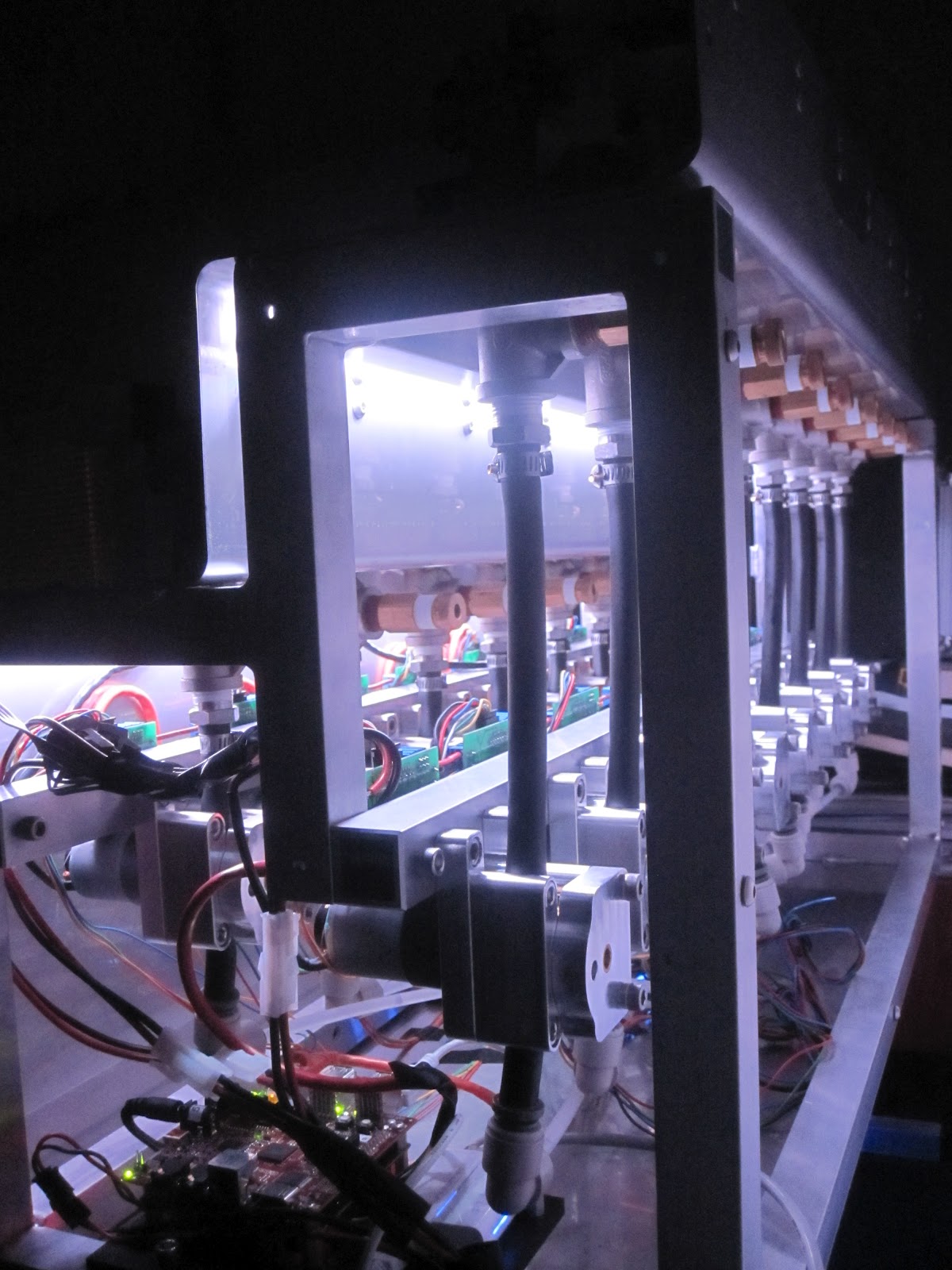
Secondly, the front is all clear so you can see the guts of the machine. When the bot was enclosed, people would need to walk behind the machine to see what was going on. This just meant that the machine had to sit on an island, which wasn't the end of the world, but it's nice to be able to access everything from the front so that the machine can easily be placed against a wall, taking less space. The new enclosure also reduces noise since the volume with the pumps is encapsulated.
Other improvements include, clean tablet mounting so that it's not in the way and won't get splashed on. Adjustable drip tray which allows the glass to be as close to the spout as possible to reduce splashing. Thinner aluminum and acrylic housing to drastically reduce weight. And, the machine can be disassembled into two major parts for ease of transport.
At our inaugural party of the new design, we beat our record by dispensing 287 drinks, or 25.8 liters of cocktails in an approximately 5 hour period.
Total Drinks Served by Bartendro so far:
OVER 1000!!!
Tuesday, August 7, 2012
Tales of the Cocktail 2012
After embarking on a 5 day journey to the beautiful city of NOLA, we have a new found respect for bartenders and the enjoyment of cocktails. This city is magical and exudes the vibe of good times.
We showed up to the Big Easy on 8/26 and as I was walking into my hotel room, I said hello to the two girls that were standing in front of the room next to mine. About 20 seconds later I heard a knock on my door, "Hey neighbor!" it was the girls with an offering of two bottles of imported wine and a wine corker, they handed it to me and said "Here keep this, welcome!" This surely set the pace for the rest of the trip. The handouts of booze, on the street seemingly to anyone that wanted them were surreal. We were handed rum and other concoctions by brand ambassadors looking to get the word out about their particular products.
As the days wore on, we learned about the format, the tasting rooms, the complimentary events, and the seminars. Our goal was simple, show a Bartendro video to as many people and see their reactions. From what we gathered, the mix of people felt like 50% bartenders, 25% brand ambassadors, distributors and other industry people, and 25% cocktail enthusiasts. Not quite what we were expecting, but it made sense after we learned that you could have bottomless cocktails for 5 days for a $45 seminar fee. We met a lot of interesting people, many of which were very opposed to the idea of Bartendro. We explained that our creation was a tool for the bartenders to help hone their craft, not to act as competition, but their answers were consistent. "That's cool, but not in my bar." Other business types were more interested, which gave us hope.
We attended the "Ins and outs of cocktails on tap" seminar. It was interesting to see how much controversy circled around using 100 year old beer kegging technology. People struggled with the issues of customer perception, keg shaking, line lengths and sanitation among others. It was eye opening. It was not the level of tech we were expecting from a cocktails on tap seminars, and astonishingly people were still very weary of such a minorly new concept.

Overall, New Orleans captivated us. The food was amazing everywhere, the people super friendly, and the cocktails second to none, even (especially) the free ones. Hopefully we will be back with more involvement, maybe as presenters, or even as sponsors. Thanks to the people that put this event on and the excitement about awesome cocktails in a warm and full of character city. Cheers!
We showed up to the Big Easy on 8/26 and as I was walking into my hotel room, I said hello to the two girls that were standing in front of the room next to mine. About 20 seconds later I heard a knock on my door, "Hey neighbor!" it was the girls with an offering of two bottles of imported wine and a wine corker, they handed it to me and said "Here keep this, welcome!" This surely set the pace for the rest of the trip. The handouts of booze, on the street seemingly to anyone that wanted them were surreal. We were handed rum and other concoctions by brand ambassadors looking to get the word out about their particular products.
Overall, New Orleans captivated us. The food was amazing everywhere, the people super friendly, and the cocktails second to none, even (especially) the free ones. Hopefully we will be back with more involvement, maybe as presenters, or even as sponsors. Thanks to the people that put this event on and the excitement about awesome cocktails in a warm and full of character city. Cheers!
Sunday, May 13, 2012
A Couple of Great Events - Barbot and Drinco de Mayo
It's amazing sometimes how much can happen in a couple months. In March, we went to Barbot 2012 in San Francisco to mingle with like minded cocktail making technologists. It was great to see familiar faces and meet new ones. Bartendro's aesthetic was spot on. It was a bold, shiny, well-lit piece of art. The bot performed admirably on Friday night dispensing 172 drinks, but we ran into some hardware/software issues that almost made the bot inoperable at the start of the Saturday run. We muscled through several issues and brought half of the pumps back to life for a usable 6 drinks. People were still impressed it could make that many, since most other bots were only doing 1 or 2 drinks. We were dismayed though because we had a selection of 30 drinks the night before. People were overall thrilled and welcoming of our robotic future, where drinks come with a button press. We got mentioned in a Make Blog about how we are "veering dangerously close to commercial viability."
Flickr Set of Barbot 2012
At the end of the event we stayed up late into the night rehashing all the things that could have gone better; a post-mortem analysis if you will. We agreed that upside down bottles were not the way to go. The upside down bottle concept carried over from our original desires to have a gravity-fed machine. The aesthetic is really cool. It seems like it would be a simple, no-fuss no-brainer; you can see the bottles and just swap them out when they run out. The problem arises when catering to larger crowds, not being able to refill the bottles as people are using the machine can cause quite a bit of downtime and this is a pretty big issue if this machine is to live in a commercial application. Also, the vent holes on the bottle caps (needed to not cause a vacuum) were prone to being leaky and messy. From looking around at the other bots this year, it seemed apparent that the winning combo is upright bottles and peristaltic pumps.
We made a long list of things to fundamentally change about our design. We would ditch the stainless steel skin and go with a simpler design. The pumps would also need a form of adjustability to reduce leakage and contamination of drinks. Over a couple of months I iterated over modification designs that would allow for adjustment with one knob. Finally, we had something worthwhile. I retrofitted the pump with new tubing to and re-routed it. Meanwhile, in software land, the UI received a face lift. Elements could now be added or removed at will depending on the type of party, things like drink size and taster buttons were made optional. Drinks could also be modified on the scales of alcohol strength and sweetness/tartness. We prepared and showed up at an event called Taco de Mayo, where our friend rents a taco truck that serves endless tacos. Naturally, our bot was transmorphed into a margarita bot. There was 6 different kinds of tequila that could be selected to go into your drink and even a game to check for sobriety if you selected the top-shelf stuff. Several other drinks could be made too including a Dirty Sanchez and White Oaxacan. 201 drink dispensed in all. Our best performance yet. We received great tips and ideas from our friends to pursue. We're going to take our technical hats off for a month and put our business ones on to try to go make this available at your favorite restaurants. Cheers!
Sunday, February 26, 2012
Light Your Bot!
In most of our projects, it seems like we always relegate LEDs to the backburner while we focus on everything else. Fortunately, we had the forethought on Bartendro to squeeze the hardware in at the design phase, even though we didn't get to work on the software side for a long while. Good LED effects are undeniable. With good placement and intelligent programming, they can make a product sing. Bartendro is case in point. The LEDs in the back are dual purpose, they light the bot with a silky purple haze for people to enjoy the view of the innards, but the color can be changed to pure white for brighter easier debugging in a perfectly dark room. The ring of RGB LEDs which hover directly over a user's cup serve many purposes. They let us know when the bot has booted and is ready for communication, and they let users know what's going on in the process of their drink creation. A pattern while it pours, and flashing green when the drink is done being poured. When all is said and done, a soft blue lets the user know that the machine is in an idle state and ready to take on more drink orders. There are even more LEDs that aren't powered up yet, which are supposed to emit focused light from the faucet. The intent is that they cue users as to where their cups should be placed. So when working on your projects, make sure to let your LEDs shine!
Sunday, February 12, 2012
The Setup
Designing a cocktail dispensing machine may not sound very difficult, but when one considers that most of the components are not readily available for purchase off the shelf, one must design their own. There are a lot of tools that go into creating a complex electro-mechanical machine like a drink bot. There are solid modeling tools, like SolidWorks and Alibre, CAM tools like SprutCam and the software that runs a the CNC machine, like Mach 3. The CNC machine is a PCNC 1100 made by Tormach, and it is a joy to use. All of the tools need to work in unison to achieve the desired results. These tools cover the basics required for machining parts. When it comes to the electronics, schematic and layout tools are required. In my case, I used EagleCAD because of the existing community and pre-made parts that allowed for fast development time. Boards can be cheaply fabricated in China by Golden Phoenix and modules from Sparkfun and Pololu make development even easier and more modular.
All software tools have their quirks, and when it comes down to it, it is just a matter of patience to learn how to use things in an efficient matter. Having these hardware and software tools in place allows us to iterate over and over tuning and refining until we are happy with the quality and performance of our creations. The tool set allows us to also make a wide array of parts, mechanisms and machines that make people's lives easier and more enjoyable. So, get some tools and start creating!
Sunday, January 29, 2012
Peristaltic Pumps
Peristaltic Pumps are not new, they are pumps that mimic peristalsis, a biological mechanism most commonly depicted as the muscle contractions of a swallowing esophagus. The vast majority of these pumps serve the medical and pharmaceutical industries. This does not bode well for hobbyists because the pumps are priced at an average of $300 each. When attempting to build a cocktail machine that dispenses over a dozen liquids, the cost becomes prohibitive.
"Why use a peristaltic pump in the first place?", you might be thinking. Well, for many reasons. The first and most obvious reason is maintenance. Since liquid does not pass through any moving parts, it becomes easy to swap out or clean hoses when necessary. In the same vein, reliability. Syrupy liquids like grenadine and Bailey's tend to gum up mechanical pumps and valves pretty quickly. Sanitation then becomes another issue when liquids become trapped in the crevices of a mechanical assembly and become impossible to clean. Finally, accuracy and simplicity are the final components that put the nail in the coffin on other approaches. While gravity valves and simple diaphragm pumps are a possibility, there is still a big issue with dealing with different densities and viscosity of liquids. Since peristaltic pumps are positive displacement, meaning they dispense the exact same amount of volume with every revolution of the motor and gearhead, it simply becomes a software problem to account for the number of motor rotations for accuracy. This is much easier and cheaper than fashioning some sort of flow rate meter.
When designing the pump, several factors need to be taken into account such as the occlusion of the tubing, the ease of assembly/dis-assembly of the tubing, maintainability and modularity. The picture shows the parts for the first batch of peristaltic pumps I made. There is a plate that the motor mounts to, a hub with sleeve bearing rollers, a shoe which is replaceable and provides the right amount of occlusion, and a support for the hub that prevents lateral motions from causing it to run to eccentrically. All in all they can be built for under $100 given the right amount of tools and resources.
Subscribe to:
Posts (Atom)